
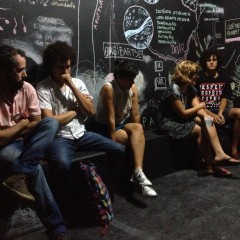
DESLOCAMENTOS < Bianca Bernardo
Sábado, 9 nov, 17h Bianca Bernardo traz ao Recife NOTÍCIAS de Santa Maria para a partir dai conversar sobre o Recife e talvez pensar uma proposição coletiva para a cidade.
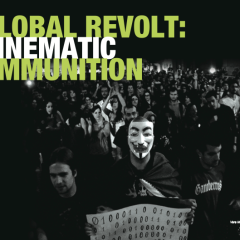
Flaherty NYC Global Revolt: Cinematic Ammunition
Tuesday, November 12, 7pm @ Anthology Film Archives Filmmaker and author Ariella Azoulay will be present for a post-screening discussion. Israel, Palestine, Syria: the unending crisis in the Middle East, unstable states caught up in a state of exception…. These films militate against the militarized state and its ideology. *FILMS* A PLATE OF SARDINES Omar Amiralay (Syria, 1997, 17 min) “The first time I heard of Israel, I was in Beirut, the conversation was about a plate of sardines. I was six years old, Israel was two.” A militant elegy, a beautifully shot meditation on history, memory, and ruin, largely framed by a conversation with fellow filmmaker Mohammed Malas, as they walk through a destroyed village. A FLOOD IN BAATH COUNTRY Omar Amiralay (Syria, 2003, 46 min) The deep pre-conditions that one cannot help but feel, ultimately led to the current revolt against the Assad dictatorship in Syria are explored with maximum rigor, elegance, and impact. Amiralay returns to site of his first film, the Assad dam on the Euphrates river. What he finds is little short of blood-curdling. THE FOOD CHAIN Ariella Azoulay (Israel/USA, 2002, 17 min) An inventive investigation of the question: Is there hunger in Palestine? leads to a disquieting conclusion: the Israeli military and government are positively nourished by the spread of humanitarian speech and ideas, which directly supports their continued aggression against Palestine. In the end the film’s title takes on a steely irony. HEZREALLAH Yann Beauvais (France, 2006, 1 min) A silent blast of flashing text, words in both English and French, at the point of self-destruction, hovering above what resembles the shimmery digital map visible in a war plane’s targeting screen. This intense 48 second film, bearing angry traces of Lettrist/ Situationist intransigence, was made during the 2006 Lebanon War. *ABOUT THE FILMMAKERS* The contentious career of the great Syrian documentarian Omar Amiralay was set in motion when, while still in film school, he joined the protests in the streets of Paris in May 1968. Always a political dissident, Amiralay made many critical films that have been enormously influential throughout the Arab world—when not banned. Ariella Azoulay’s work, she says, uses “images to revise political concepts — that of citizenship and sovereignty first and foremost — in order to understand Palestine in the larger global context of revolution, colonial legacy, imperialism, and of what is left over after imperialism.” Perhaps the most influential contemporary theorist of photography, as well as a filmmaker, she teaches at Brown University. She is the author of Civil Imagination: The Political Ontology of Photography, among other books. Perhaps the major French exponent of experimental cinema, Yann...
José Agrippino de Paula
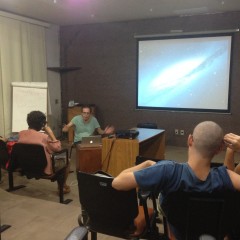
Ciclo: O Tempo das Imagens José Agrippino de Paula, nasceu em 1937, e morreu em 2007. Dramaturgo, cineasta e músico, José Agrippino de Paula é conhecido como escritor de Lugar Comum e Panamérica, considerada por Caetano Veloso a obra fundamental do Tropicalismo. Em 69, ele fez Hitler 3° Mundo, um dos filmes mais radicais do cinema brasileiro e que foi mostrado no Brasil somente depois 1982. Em 2010 sua obra foi contextualizada em um ciclo no Centre Pompidou, Paris. Curso de cinema experimental, promovido por B³ através de aprovação pelo edital do Funcultura, com o apoio da diretoria de Memória, Educação, Cultura e Arte da Fundação Joaquim Nabuco, e se constitui de 12 palestras nas quais o cineasta e ensaista yann beauvais desenvolve temas sobre a imagem em movimento. Ciclo: O Tempo das Imagens 5 Novembro 2013, 19h FUNDAJ: Sala Aloísio Magalhães, Rua Henrique Dias, 609, Derby, Recife...
It’s not a bug, it’s a feature: the rise of glitch art
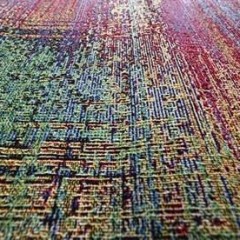
Artists are using the familiar glow of digital glitches to create work that questions the forms and traditions of art theguardian.com, Friday 25 October 2013 10.34 BST Philip Stearns used patterns sourced from short-circuited cameras and malfunctioning hardware to create textiles. Photograph: Philip Stearns Glitches. We’ve all seen them: an unexpected blast of pixelated, hallucinatory jagged lines spreading across our TVs and computer screens. A digital bug fractures the image we’re looking at and, for a frustrating moment, interrupts the film, game or photograph before it returns to normal. Glitch art takes temporary pixelations, interruptions and glitches and turns them into visually arresting pieces, questioning the forms and traditions of art using digital techniques. Luke Jerram’s sculpture at Bristol Temple Meads station, with his daughter Maya in the background. Photograph: Toby Farrow/Farrows CreativeSince July, puzzled commuters on platform one at Bristol Temple Meads train station have been able to see a lone figure of a young school girl in the distance. On closer inspection, the girl fractures and turns into blocks. She is the work of Luke Jerram, a colour-blind artist who creates work on and researches optical illusions and visual perception. The young girl is based on a scan of Jerram’s daughter, Maya, which is also the name of the sculpture. Maya was scanned using an X-box Kinect and equipment at Machine Vision Laboratory in Bristol. The scan was then pixelated into squares called voxels. Precision-cut aluminium formed the bulk of the sculpture, with more than 5,000 square stickers, measuring 12mm each, carefully applied to the aluminium to create the finished piece. An image from the Melting Ice Cream series by Mathieu St-Pierre. Photograph: Mathieu St-PierreMathieu St-Pierre, a Canadian artist, uses computer programmes and analogue video signals to create his images, drawing on electronic malfunctions as a creative element. His “abstraction” pieces created in 2012 are kaleidoscopic colour-scapes with the familiar glow of digital glitches. However, St-Pierre has used the digital faults to create saturated pieces with wavering, repetitive lines like brushstrokes in a reflective sea of colour. Taking this concept further, Phillip Stearns of Glitch Textiles brings together fabrics with digital art, launching his crowd-sourced project in 2011. Patterns sourced from short-circuited cameras and malfunctioning hardware are transformed into tactile wool weaves and soft fabrics with bright algorithmic patterns. Another artist, the London-based Quayola, used video installation at Palais de Beaux Arts in Lille in October 2011, to pixelate the classic paintings of Rubens and Van Dyck in the Flemish collection. A precise computerised process splits up sections of the painting and turns them into blocks and 3D shapes. Smooth canvas is broken up and interrupted into...
arTTrainee 2013
Dar visibilidade a um trabalho que vem se desenvolvendo lentamente em Bcubico, desde abril, é o motivo desta mostra que reúne 17 bolsistas ( solo e duplas), contemplados como contrapartida do financiamento do Edital Funcultura Independente 2012. A diversidade da mostra evidencia o processo arTTrainee aberto a uma demanda interessada de artistas, não-artistas, corpos desejantes, corpos-máquinas de diversas idades e períodos de produção e trabalho muito distintos, ávidos em discutir as suas produções, dar vazão a novas inquietudes, refletir a criação, e a des-motivação produtiva. Aqui, nesses 6 meses, com horário previamente agendado, conversamos sobre os processos de cada bolsista dentro de suas questões específicas. Assessorado das ferramentas de pesquisa da internet, de livros, revistas, textos de historiadores e críticos, e, imagens de trabalhos de artistas, que nos ajudam a mapear as operações plásticas e conceituais de cada um. São artistas dispostos a trocar idéias, falar de seus trabalhos, mostrar o que vêm fazendo. A maioria, ainda é inédita, mas nem por isso menos interessada e conectada com as questões que a arte suscita. O arTTrainee funciona como uma espécie de terapia. É gratuito, e tem recebido artistas de outras cidades e regiões também, já que é aberto a quem quiser participar. Qualquer um que desenvolva trabalhos voltados para a arte pode se inscrever e agendar um horário para discutir o próprio trabalho, processo, de criação, desenvolvimento de linguagem, dúvidas quanto à apresentação e exibição de sua obra. E volta quantas vezes achar necessário.” Seu aspecto clínico parte da vontade de desmanche de alguns “redemoinhos” do fluxo-criativo-poético. Anamnese esquizoanalítica, o arTTrainee não resgata nem adereça nenhum artista para o circuito estabelecido da Arte, mas proporciona linhas de fuga a um sistema paranóico da crição, centrado em processos e noções, por vezes, engessadores da produção. Rubens Pileggi, escreveu na coluna Alfabeto Visual da Folha de Londrina (2001) : “Treinar, trainnee, fazer aparecer, realizar. Arte também depende de treinamento, e mostrar o trabalho faz parte do exercício. Como uma espécie de aula, onde cada um aprende o que quer e tira de si o que sabe. E poderia também se chamar Programa de desbloqueio. Ou Terapia para obras de artistas. Ou consultoria técnica do sensível. Assim, o “Arttrain’ee” pode ser pensado como uma referência para se discutir arte, se potencializando à medida em que vai se transformando a cada edição.” Diferente de uma exposição de resultados, esta mostra, também é um momento de aceleração e cristalização dessa reflexão. É uma situação onde a virtualidade dos processos se sedimenta e se presenta no espaço expositivo relacionando-se com as outras propostas. Ou seja, a exposição é vista aqui como um laboratório, é um...